The term narcissism gets thrown around a lot in our selfie-obsessed culture, usually to describe someone who seems exceptionally self-centered. We use it when describing co-workers, bosses, celebrities, exes and even pastors. The term narcissist is derived from Narcissus, which comes from the Greek word narc meaning, “numbness.” Narcissists are oblivious to their own pain and the pain they inflict on others. Narcissism may be the current catchword, but it’s nothing new. Self-centered, arrogant, evil people have been around as long as humans have existed.
According to psychologist Dr. Patricia Lindquist, narcissism is a developmental stage in early childhood, lasting from the age of two until around five. “It is essential to self-concept, self-esteem, and ability to act in one’s own behalf independently. We have to ‘love ourselves’ in order to have the stamina and motivation to become an independent self.” This stage is mostly complete by the time an individual reaches the young adult stage.
The other, more problematic form of narcissism, often called “malignant narcissism,” is the version we are most familiar with. This person “intertwines themselves with others, unable to stand independently, and manipulates others to provide what is needed” Lindquist explains. “What makes it malignant is that it is not a whole relationship. It is a one-person relationship who contrives, manipulates, even gaslights others to obtain needed resources. This individual as an adult has many broken relationships, many frenemies, and is constantly ‘putting on a show’ in a charming way to lure others to him/her, to be discarded as soon as someone more exciting appears on the horizon.”
In their paper Birth Cohort Increases in Narcissistic Personality Traits Among American College Students, 1982–2009, Jean M. Twenge and Joshua D. Foster reported that approximately 70 percent of students today score lower on empathy and higher on narcissism than the average student 30 years ago.
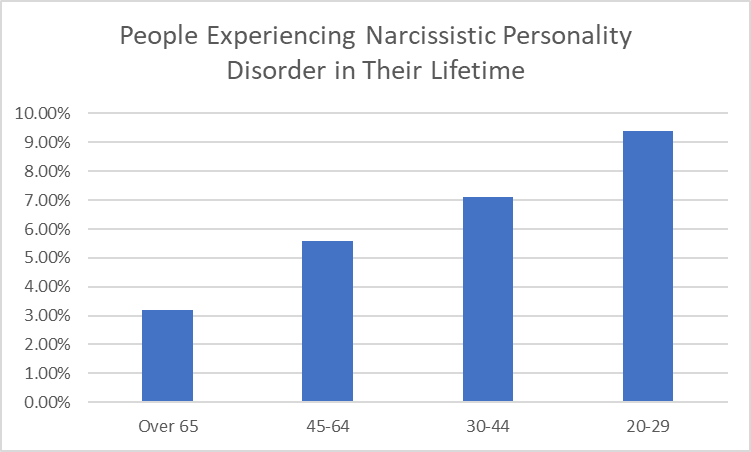
Narcissistic Leaders
If asked, most people would say that Jesus’ most important qualities were gentleness and compassion. He taught us to turn the other cheek when we are attacked. Christianity teaches us to follow the example of Jesus, so how can there be narcissism in churches and church leaders?
Manipulation may not seem like it belongs in a church, but there are many narcissists involved in churches. Some are the ordained leader—a priest, pastor, minister, reverend—and others are non-ordained leaders in the congregation. Lindquist believes that there is as much narcissism in the church as in the general population
It is easy to see why narcissists would be drawn toward ministry. As Chuck DeGroat, who is both an ordained minister and licensed therapist, explained during an Allender Center podcast in their narcissism series, “we give immense deference to people in pastoral ministry, pastoral power, because of position, title, authority, robe, clerical collar, and all the rest.”
In his paper Narcissistic Pastors and the Making of Narcissistic Churches, Darrel Puls wrote, “Narcissists require constant external admiration to be reassured of their self-esteem. The position of pastor would be quite attractive to those who crave such admiration, as it is central to the drama of worship and religious exercise.”
Puls continues that the position “offers continuous gratification through telling people how to live with holy writ for a guide, being an integral part of the joys and tragedies of life, being told people’s deepest fears and darkest secrets, being sought out for advice and counseling, and being invited to banquets and intimate dinners as the honored guest. Such glory and power might seem quite attractive to a narcissist.”
The Rev. Bekki Lohrmann described seminary as the set-up for narcissism. She said that students are constantly being told that they are the authority in the church, they are God’s conduit to the congregation, they are the spiritual leader of the congregation. What wouldn’t draw a narcissist in?
But church leaders aren’t all ordained. A narcissist might be the person controlling the money, wanting to decide where “their” money goes. It might be the council president, wanting to choose the direction the church will move in. It might be a music director or singer, wanting all attention focused on them and their gifts to the congregation.
The Rev. William Radatz pointed out that it’s a very human trait to believe that we are the center of the universe. “There is a tendency in all of us to want to step up and basically be God.” In an article for The Banner, DeGroat wrote, “Adam and Eve’s original temptation was to “be like God” (Gen. 3:5), transcending their God-ordained creatureliness.”
Bishop Andrew Taylor agreed, saying, “I think the root of sin is selfishness, and narcissism is just a part of selfishness. All of us tend to go back to our selfishness in a variety of ways.”
Sister Anne of the Mount Saint Benedict Monastery in Crookston, Minn. pointed out that it can be very hard to identify a narcissist. “We all have a little bit of it in us. A lot of people have a hard time admitting mistakes. You want to be fair. And most of us don’t have the training to recognize it.”
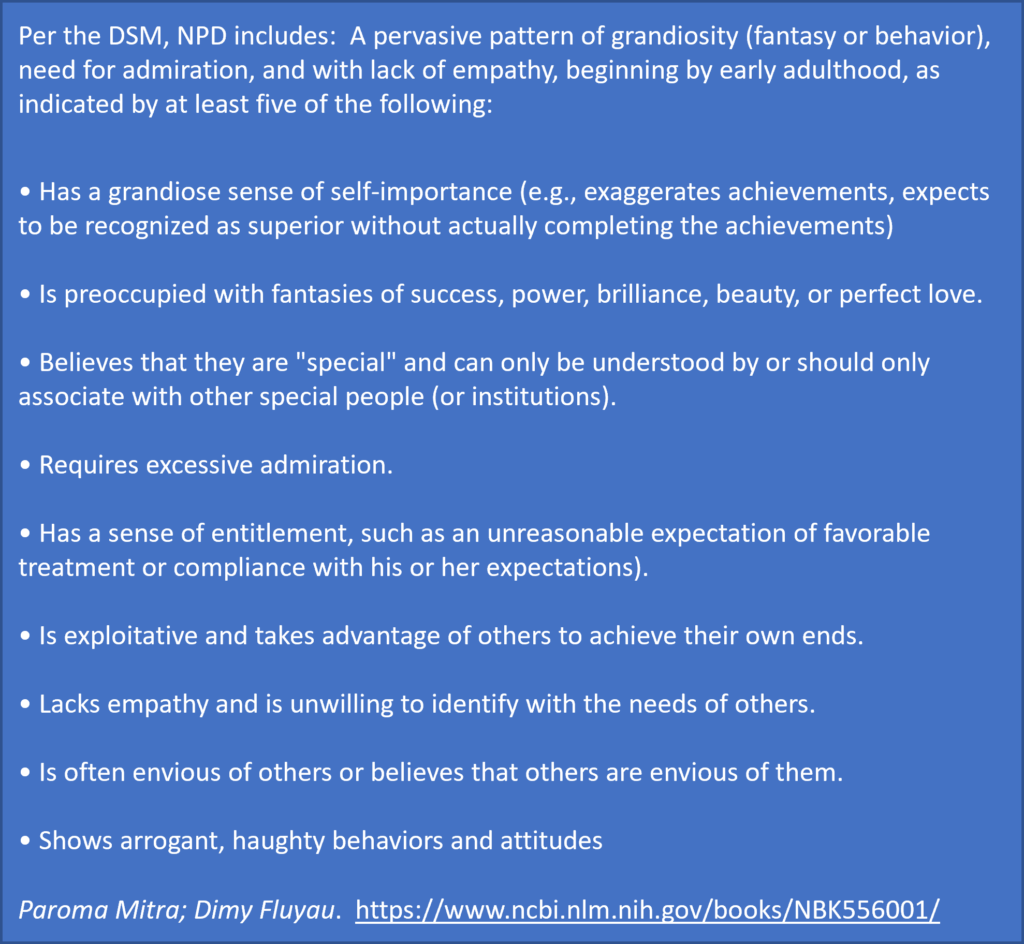
Narcissistic Church
But it isn’t just the leaders of the church who may be narcissistic. The church itself can sometimes be. Radatz says that for each person in the church, “there’s a balance of ‘what do I get out of this’ and ‘what good can I do?’ When the balance is off, there’s an issue. It becomes about reinforcing my beliefs and convictions rather than a place we are learning together.”
He also pointed out that all churches, particularly the more fundamentalistic churches, have a conviction of absolute right, that “we have the correct bent on the truth.” Yet we have seen that in trying to avoid sin, churches propagate sin, i.e., desiring to protect unborn children can lead to a callous disregard for women’s lives.
“We have to be careful about how we understand who God is and how God is. If we in the church portray God as a figure who alone wants to be the center of our universe, who is alone the object of our admiration then we are casting God in a narcissistic image. And if we have a narcissistic God, then we can expect to find narcissism in the church,” Lohrmann explains.
Narcissism in the church has become an increasing concern. Puls’ paper was written in October 2020. DeGroat’s book, When Narcissism Comes to Church: Healing Your Community from Emotional and Spiritual Abuse, was published in March 2020.
One potential explanation for the increase in narcissistic churches is that church attendance is declining.
As Lohrmann expounded: “We know that apart from major personality disorders, narcissism is a natural byproduct of stress, struggle, and trauma. When we feel like we are falling, we naturally think of ourselves. Drowning people are not altruistic, they will steal lifeboats from each other in order to survive. The church right now is in a period of decline and so often it has turned congregations and leaders inward, reducing the mission of the church from a vibrant effort to share God’s love to a desperate effort to acquire new members for our own survival. And if this kind of narcissism is permeating church culture, then it will surely draw narcissistic leadership.”
What happens to churches that become narcissistic? The short answer is that they become cults. They become centered around a perceived powerful leader. The members follow their leaders in almost a cult-like way because of their own feelings of powerlessness, deficiency, insecurity.
According to Dr. Dan Allender of the Allender Center, shared in the episode of his podcast featuring DeGroat, people who feel disenfranchised gather around a particularly powerful leader. “They’re not going to come in and listen daily, weekly, to somebody who is offering a love-oriented, humble, spirit of servanthood-oriented approach to the Christian life. They want to hear we are in a war. We need to fight this war. We are being bombarded. In other words, it seems like narcissism has the ability to shift so quickly to a sense of victimhood.” Then they are willing to follow the leader anywhere.
Over time, members who see the narcissism will leave, which only strengthens the cult-like character of the church. Narcissistic pastors tend to surround themselves with their own “disciples” and the leadership becomes insular and self-serving. The staff suffers greatly. People who must deal with a narcissist must be in a constant state of alertness. The frequent chaos and instability create a continuous state of stress. This can lead to chronic illness, mental health problems and other symptoms related to constant trauma.
Lindquist shared that her husband, the late Rev. Jack Lindquist, “used to joke about having enough ego to ‘speak to God’ and proclaim God’s words, saying that anyone who did that had to be a little crazy.” Narcissistic people may not be crazy, but when they are in positions of leading people’s souls, they can inflict a lot of trauma.
In an interview by Jamie D. Aten Ph.D. for Psychology Today, DeGroat said, “When I think about how narcissism impacts the church, I’m immediately aware of the debris field of pain—broken relationships, vocational confusion, trauma symptoms, betrayals of trust, to name a few.”
